
Best Spanish Learning App: Finding the Right One for You

Summary
- The "best" app depends on your specific situation—learning style, goals, schedule, and current level all matter more than overall app ratings
- Look for apps with four key features - daily engagement, active speaking practice, personalization, and low friction to start
- Traditional apps suit systematic learners wanting structure; conversation apps suit those wanting to speak quickly; hybrid apps try to offer both
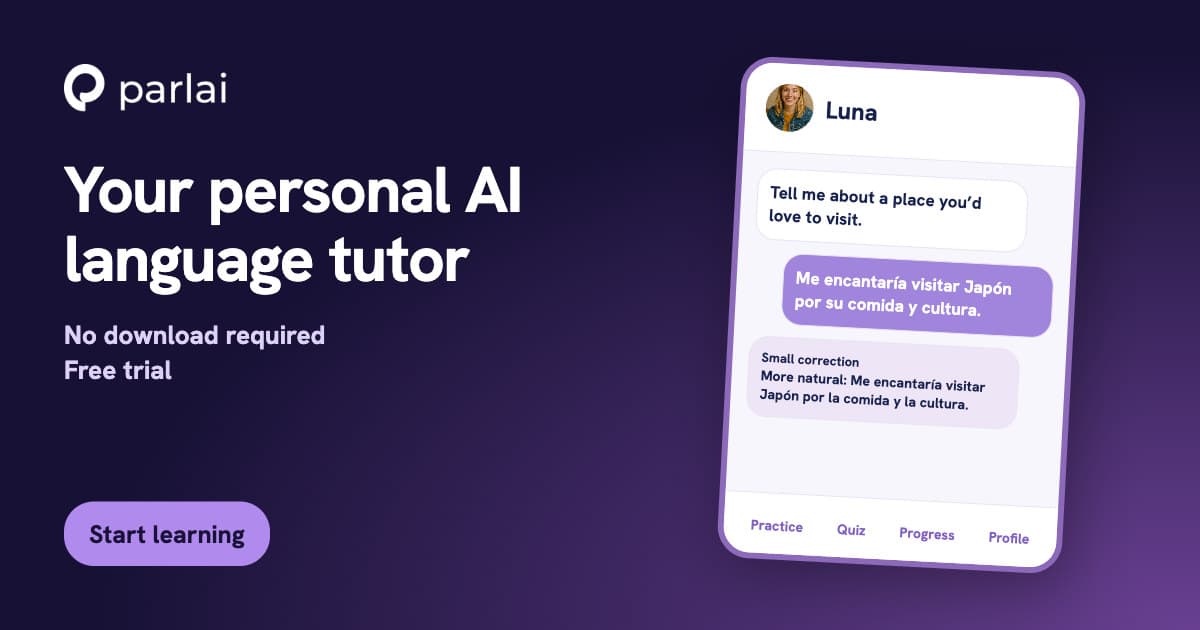
- Chat with Luna, build vocabulary in Quiz, and practice speaking in a call. See your progress in Profile and Progress.
Practice your way
Get instant speaking and listening drills, anytime.
Table of Contents
What's the best Spanish learning app? With dozens of options, all claiming to be the best, choosing can feel overwhelming. The honest answer is that the "best" app depends entirely on you.
Hannah, a 28-year-old teacher, tried four different Spanish apps before finding one that worked. The apps that friends recommended didn't fit her schedule. The apps with the highest ratings felt boring to her. She finally succeeded with an app that matched her specific learning style and daily routine, not the objectively "best" app.
Here's how to find the right app for your specific situation.
What Makes an App "Best" for You
The best Spanish app isn't universal, it's personal. Several factors determine which app will actually work for your situation.
Your Learning Style
Structured learners prefer clear progression: Level 1, then Level 2, then Level 3. They like knowing what comes next and tracking their progress through defined stages.
Flexible learners prefer following their interests. They want to learn what's relevant to them today, not what a curriculum dictates.
Visual learners need to see words written and connect them to images.
Auditory learners need to hear pronunciation and repeat aloud.
Different apps favor different styles. Traditional apps tend to favor structured visual learning. Conversation apps favor flexible auditory learning.
Your Goals
Match your learning style
Structured learners → traditional apps; flexible learners → conversation apps
Match your goals
Conversation → speaking apps; vocabulary → flashcard apps; grammar → lesson apps
Match your schedule
Consistent time → most apps work; irregular time → apps with micro-sessions
Four key features
Daily engagement, active speaking, personalization, low friction
The consistency test
The best app is the one you'll use daily, not the one with best reviews
Parlai advantage
Apps in your existing chat routine eliminate the friction of building new habits
Different App Types Explained
Traditional/Structured Apps
Examples: Duolingo, Babbel, Rosetta Stone, Busuu
How they work: Structured lessons progress from beginner to advanced. Gamification (points, streaks, leaderboards) motivates continued use. Vocabulary and grammar are taught through exercises.
Best for:
- Complete beginners who need foundations
- Systematic learners who like clear progression
- Visual learners who need to see words
Limitations:
- Limited real conversation practice
- Can feel like homework after novelty fades
- May not build actual speaking fluency
Conversation-Based Apps
Examples: AI tutors, chat-based learning, speaking-focused apps
How they work: You practice through real conversations, usually with AI or language partners. You learn by doing, not by studying rules first.
Best for:
- Learners who want to speak quickly
- Intermediate learners who know grammar but can't produce it
- People who learn by doing rather than studying
Limitations:
- Less structured than traditional apps
- May have gaps in grammar explanation
- Requires self-motivation
Hybrid Apps
Examples: Various premium language platforms
How they work: Combine structured lessons with conversation practice. Try to offer the best of both approaches.
Best for:
- Learners who want comprehensive coverage
- Those who can dedicate more time daily
- People who want structure AND practice
Limitations:
- Can be overwhelming with too many features
- Often more expensive
- May do neither approach excellently
Practice with an AI tutor
When learning happens where you already chat, friction disappears completely.
Easy access: Open Parlai on your phone or computer. No download is required. Add a short practice session to a routine you already have.
Natural context: Chatting in Spanish in Parlai feels natural, not like studying. The format matches real communication.
Always available: No scheduling, no waiting. Practice during any free moment throughout your day.
Hannah's breakthrough came when her Spanish practice moved to Parlai. She didn't have to "find time" anymore, practice happened naturally in the moments between her existing Parlai conversations.
Quick Choosing Guide
Choose traditional apps if: You're a complete beginner, you like structure, you're a systematic learner, you need vocabulary foundations.
Choose conversation apps if: You want to speak quickly, you're intermediate level, you learn by doing, you prefer natural learning.
Choose hybrid apps if: You have time for comprehensive study, you want structure AND practice, you don't mind navigating features.
Choose AI conversation practice if: You want flexible practice, automated feedback, and an opportunity to use the language in conversation. AI feedback can be wrong, so use human guidance when needed.
The Bottom Line
The best Spanish learning app isn't the one with the most features, best reviews, or highest ratings. It's the one that matches your learning style, serves your goals, fits your schedule, and that you'll actually use daily.
Hannah tried four apps before finding her match. The winning app wasn't objectively "best", it was best for her specific situation.
Practice 30 languages with Luna. Chat, send voice messages, take quizzes, and make calls with useful feedback.
Frequently Asked Questions
Consider your learning style (structured vs. flexible), your goals (conversation vs. grammar), your schedule (daily consistency vs. weekly), and your current level (beginner vs. intermediate). The "best" app is the one matching these factors that you'll actually use daily.
Free apps work well for vocabulary basics and initial exposure. Paid apps typically offer better conversation practice, personalized feedback, and fewer distractions. If budget allows, paid conversation apps usually accelerate fluency faster. If not, combine free vocabulary apps with free language exchange.
Yes, but limit to 1-2 apps to avoid scattered progress. A good combination is one vocabulary/grammar app and one conversation app. Using too many apps creates decision fatigue and makes daily habits harder to maintain.
Apps match different learning styles and life situations. An app that works for someone with flexible time may not suit someone with a rigid schedule. An app for visual learners may frustrate auditory learners. Match the app to your specific situation, not to someone else's recommendation.
Give an app 2-3 weeks of consistent daily use before judging. Initial impressions can be misleading—an app that feels hard at first may become comfortable, while an app that feels easy may prove shallow. If you're not seeing any progress after 3 weeks, try something else.
Not sure where to start?
Find your estimated CEFR level with 12 questions, then see exactly what to improve next.
Related Articles
Ready to Start Your Language Learning Journey?
Join thousands of learners who are already improving their language skills with Parlai.