
Best App to Learn Spanish: 2026 Comparison & Reviews
Summary
- The best app is the one you'll use daily; consistency beats features—10 minutes daily with a simple app beats occasional use of a comprehensive one
- Look for real conversation practice, not just vocabulary drills; speaking practice accelerates fluency 3-5x faster than passive exercises
- Traditional apps (Duolingo, Babbel) excel at vocabulary basics; conversation apps build speaking confidence; choose based on your primary goal
- Low friction integration matters most; apps that fit your existing routine get used consistently, while complicated apps get abandoned
Practice your way
Get instant speaking and listening drills, anytime.
Table of Contents
What's the best app to learn Spanish? With so many options, Duolingo, Babbel, Rosetta Stone, AI tutors, and dozens more, it's hard to know which one actually works. Most reviews just list features without explaining what matters for real learning.
Here's a comparison based on what the research says works, not just what looks good in screenshots.
Maria, a 30-year-old marketing manager, spent two years trying different Spanish apps. She had a graveyard of deleted apps on her phone, each one started with enthusiasm, used for a few weeks, then abandoned. When she finally found success, she realized the "best" app wasn't the one with the highest ratings. It was the one that fit her life.
What to Look For in a Spanish App
Before comparing specific apps, understand what actually matters for language learning.
Daily Practice Capability
For vocabulary basics
Traditional apps (Duolingo, Babbel) with gamified drills and structured lessons
For speaking fluency
Conversation apps with AI tutors and real-time feedback
For listening skills
Audio-based apps (Pimsleur) with repeat-after-me exercises
For comprehensive learning
Hybrid apps with multiple modes (more expensive, can be overwhelming)
For maximum consistency
Low-friction apps that integrate with daily habits (browser-based)
The key
The best app is the one you'll use daily, not the one with the most features
App Types for Spanish Learning
Speaking Practice
Best For
Weakness
Cost Range
Visual Summary: Choosing the Best Spanish App
- For vocabulary basics: Traditional apps (Duolingo, Babbel) with gamified drills and structured lessons
- For speaking fluency: Conversation apps with AI tutors and real-time feedback
- For listening skills: Audio-based apps (Pimsleur) with repeat-after-me exercises
- For comprehensive learning: Hybrid apps with multiple modes (more expensive, can be overwhelming)
- For maximum consistency: Low-friction apps that integrate with daily habits (browser-based)
- The key: The best app is the one you'll use daily, not the one with the most features
Traditional Learning Apps
Examples: Duolingo, Babbel, Busuu, Memrise
What they do well:
- Excellent for building vocabulary foundations
- Gamification can motivate beginners
- Clear progression from beginner to advanced
- Usually have free tiers
What they lack:
- Limited real speaking practice
- Can feel like homework after the novelty wears off
- Gamification becomes tedious over time
- May not build actual fluency
Best for: Complete beginners who need vocabulary and grammar basics before speaking practice.
Maria used Duolingo for her first three months. It helped with vocabulary but didn't prepare her for real conversations. She still froze when someone spoke to her in Spanish.
Conversation-Based AI Apps
Examples: Parlai, various AI tutoring apps
What they do well:
- Real speaking practice available 24/7
- Immediate feedback on pronunciation and grammar
- Natural conversation feels less like studying
- Builds confidence through practice
What they lack:
- Less structured progression
- Requires self-motivation
- May need supplementary vocabulary practice
Best for: Learners who want to speak quickly and build confidence through natural conversation.
Maria's breakthrough came when she added conversation practice. Within two months, she could hold basic conversations, something two years of vocabulary apps hadn't achieved.
Audio-Based Apps
Examples: Pimsleur, Michel Thomas
What they do well:
- Focus on listening and pronunciation
- Work during commutes (audio-only)
- Structured methodology
- Good for auditory learners
What they lack:
- Passive, you listen more than speak
- Can't practice spontaneous conversation
- Fixed curriculum, less adaptable
- No real-time feedback
Best for: Learners with long commutes who want to practice pronunciation and listening.
Comprehensive Apps
Examples: Rosetta Stone, Babbel Premium
What they do well:
- Cover vocabulary, grammar, speaking, and listening
- Professional curriculum design
- Structured progression
- Good production quality
What they lack:
- Expensive compared to alternatives
- Can be slow-paced
- Feature overload can be overwhelming
- Still limited real conversation
Best for: Learners who prefer all-in-one solutions and have budget for premium apps.
What Actually Works (Based on Research)
The research on language learning is clear about what builds fluency:
Consistency Over Intensity
10 minutes daily beats 2 hours weekly. Your brain consolidates learning between sessions. Daily practice compounds; occasional practice doesn't.
Maria's failed attempts all involved ambitious study plans she couldn't maintain. Her successful attempt? Just 15 minutes daily, without exception.
Speaking Practice Over Passive Learning
Active speaking practice accelerates fluency 3-5x faster than passive recognition exercises. You can recognize 5,000 words but still freeze when someone speaks to you. Speaking practice builds the production ability that passive learning doesn't.
Immediate Feedback Over Delayed Review
Getting corrected while speaking is far more effective than reviewing mistakes later. Real-time feedback creates stronger memory connections between errors and correct forms.
Integration With Daily Life
The app that fits your routine beats the "better" app that doesn't. If you have to "find time" to study, you probably won't. If practice happens naturally in your existing habits, it becomes automatic.
The Consistency Question
Here's the truth most app comparisons avoid: feature lists don't matter if you don't use the app.
Maria's seven failed apps all had excellent features. They had vocabulary games, speaking exercises, progress tracking, and more. But they all required her to "sit down and study", which competed with everything else in her life.
Her successful app didn't have the most features. It had the lowest friction. She could practice during her commute, during lunch, or while waiting in line. It fit her life instead of demanding she change her life.
How to Choose: Decision Framework
Choose traditional apps if: You're a complete beginner who needs vocabulary basics. You enjoy gamified learning. You prefer structured progression.
Choose conversation apps if: You want to speak quickly. You've got basic vocabulary and need practice using it. You prefer natural learning over drills.
Choose audio apps if: You have long commutes. You're an auditory learner. You want to practice during activities where you can't look at a screen.
Choose comprehensive apps if: You have budget for premium. You want everything in one place. You don't mind slower progression.
The Bottom Line
The best app to learn Spanish is the one you'll use every day. Not the one with the highest ratings, the most features, or the best reviews. The one that fits your life.
Look for:
- Low friction, can you start practicing immediately?
- Real conversation, are you actually speaking?
- Daily reminders, does it help build habits?
- Immediate feedback, does it correct mistakes in real-time?
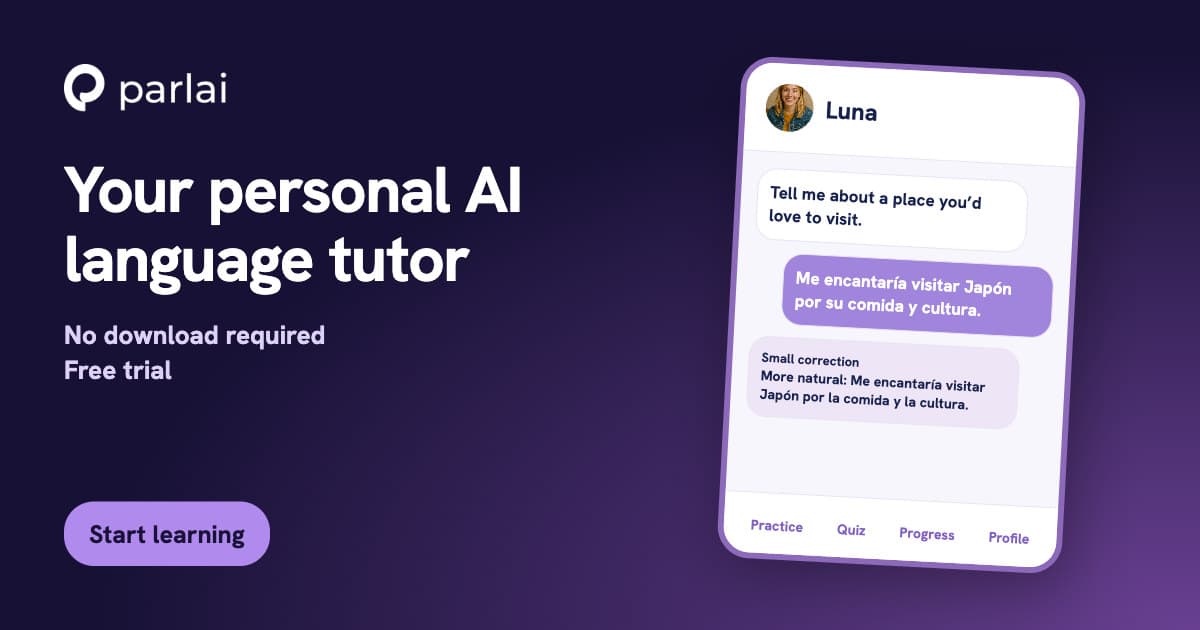
Practice 30 languages with Luna. Chat, send voice messages, take quizzes, and make calls with useful feedback.
Remember: Maria tried seven apps before finding success. The winning app wasn't objectively "better", it was better for her life. Find what works for you, not what works in theory.
Frequently Asked Questions
For free options, Duolingo is the most popular and offers solid vocabulary and grammar foundations. However, free apps typically lack real conversation practice. For speaking fluency, you'll eventually need either paid conversation practice or creative alternatives like language exchange apps.
No single app does everything well. Traditional apps excel at vocabulary; conversation apps build fluency; neither replaces the other. Most successful learners use one app for vocabulary review and another for speaking practice. Trying to find one perfect app usually leads to disappointment.
After 2-4 weeks of daily use, you should notice improvement in the skills you're practicing. If you're using a vocabulary app, you should recognize more words. If you're using a conversation app, you should feel more comfortable speaking. If you don't see progress, the app may not match your learning style.
Different apps work for different people based on learning style, goals, and daily routine. The "best" app depends on what you'll actually use consistently. Open Parlai on your phone or computer for a short practice session. Choose a regular time and enable reminders in Profile if they help.
Using 1-2 apps is ideal. Too many creates scattered progress and decision fatigue. A good combination is one vocabulary/grammar app (for review) and one conversation app (for speaking). More than that usually means you're avoiding the hard work of actually practicing.
Not sure where to start?
Find your estimated CEFR level with 12 questions, then see exactly what to improve next.
Related Articles
Ready to Start Your Language Learning Journey?
Join thousands of learners who are already improving their language skills with Parlai.