
Speaking Spanish: Tips & Conversation Strategies

Summary
- Speaking improves fastest when you practice output daily; even 10 minutes beats weekly marathons
- Confidence comes from communication, not perfection; mistakes are the fastest feedback loop
- Use conversation scaffolds and reusable patterns to keep momentum when you get stuck
- A short, structured routine (warm‑up, talk, repair, review) builds fluency faster than passive study
- Combine speaking with light input to keep vocabulary fresh and natural
Practice your way
Get instant speaking and listening drills, anytime.
Table of Contents
Speaking Spanish is the goal, but confidence rarely comes from memorizing rules. It comes from using the language in real moments — even small ones — until speaking feels normal. The good news: you don’t need hours a day or a perfect partner. You need a simple, repeatable system that makes daily speaking feel low‑pressure.
When Alex moved to Barcelona for work, he could read Spanish fairly well, but froze in conversations. He understood most of what people said, yet couldn’t respond quickly enough. What helped wasn’t more grammar. It was daily speaking practice with tiny, structured routines that removed the pressure to be perfect.
Below is a practical framework to make speaking Spanish feel natural.
Why Speaking Feels Hard (Even When You “Know” Spanish)
Speaking is different from reading or listening. It forces you to retrieve words in real time, assemble them into a sentence, and say them out loud — all while thinking about the meaning. That’s why many learners “know” Spanish but can’t speak it smoothly.
Common friction points:
- Translation delay: You think in English, then translate.
- Fear of mistakes: You stop yourself before speaking.
- Vocabulary gaps: You know the word when reading, but not when speaking.
- Pressure for perfection: You hold back until it sounds perfect.
The fix is not more theory. It’s more output — short, consistent speaking practice that makes retrieval automatic.
The Mindset Shift That Unlocks Fluency
Communication beats perfection. Most native speakers don’t care about small grammar errors. They care about understanding you. If your message is clear, you’re already speaking.
Mistakes are information. Every mistake is a data point. It tells you exactly what to practice next. The fastest learners treat errors as guidance, not proof of failure.
Confidence is built, not found. You don’t wait until you feel confident to speak. You speak until you feel confident.
Conversation Scaffolds That Keep You Moving
When you get stuck, use scaffolds — simple, reusable phrases that buy time and keep the conversation alive:
- “Déjame pensar…” (Let me think…)
- “¿Cómo se dice…?” (How do you say…?)
- “Quiero decir que…” (I want to say that…)
- “No estoy seguro, pero…” (I’m not sure, but…)
These phrases are like training wheels. They let you continue speaking while you search for the next word.
Conversation Prompts That Actually Work
When you practice speaking, “Talk about your day” can feel too open‑ended. Use prompts that naturally create more language:
- Explain a decision: “Why did you choose that?”
- Describe a change: “What was different this week?”
- Compare two options: “Which is better and why?”
- Tell a short story: “What happened from start to finish?”
Prompts like these push you to connect ideas, not just list facts.
Fear of Mistakes: The Real Blocker
Many learners know enough words to speak, but hesitate because they fear sounding “wrong.” This fear is normal — and it fades when you collect evidence that people still understand you.
Try this experiment: speak for two minutes without stopping, then ask your partner or tutor to summarize what they understood. You’ll be surprised how much meaning gets across even with imperfect grammar.
This routine keeps practice short, realistic, and repeatable.
Strategies That Actually Improve Speaking
1) Speak Before You Feel Ready
Start with basic sentences. The goal is not elegance — it’s momentum. Once you can keep a conversation going, refinement becomes easier.
2) Focus on Reusable Patterns
If you can use patterns like “Quiero + infinitive”, “Tengo que + infinitive”, and “Me gustaría + infinitive”, you can say hundreds of ideas with a small toolkit.
3) Use Micro‑Conversations
Talk to yourself in short bursts:
- Describe what you’re doing.
- Summarize a podcast in two sentences.
- Answer a simple question out loud.
These micro‑conversations keep Spanish active in your brain without needing a partner.
4) Practice “Repairing” Mistakes
Fluent speakers repair in real time. Try this:
- Say a sentence quickly.
- Repeat it with a correction.
- Repeat again with a better word choice.
This builds automatic self‑correction without breaking fluency.
Fluency vs Accuracy: Which Comes First?
If you focus too much on accuracy, you stop speaking. If you ignore accuracy completely, you build bad habits. The sweet spot is:
- Speak first
- Refine after
- Repeat with better phrasing
That’s why short daily speaking sessions are so powerful — they create repetition with improvement.
Pronunciation Without Anxiety
Clear pronunciation matters, but it doesn’t have to block your speaking progress. Focus on the biggest clarity wins first:
- Pure Spanish vowels (a, e, i, o, u)
- “J” sound (like English “h”)
- Rolling “rr” (only if it blocks understanding)
You can improve pronunciation alongside fluency. Speaking daily is what makes the difference.
What to Do When You Don’t Have a Partner
You can still practice speaking effectively:
- Voice notes: Record yourself and replay.
- Shadowing: Repeat a short native clip immediately after hearing it.
- Roleplay: Act out a real scenario (ordering, explaining your job, small talk).
- Prompt cards: Write 10 prompts and answer one each day.
Consistency matters more than the format.
A Simple Weekly Speaking Plan
- Mon/Tue: 10‑minute routine + 5 minutes of review
- Wed: 10‑minute routine + 1 longer story (2–3 minutes)
- Thu/Fri: 10‑minute routine + correction focus
- Weekend: 15–20 minutes of free conversation
This plan is realistic and keeps the habit intact.
Roleplay Scenarios That Build Real Confidence
Roleplay is powerful because it simulates real pressure with low stakes. Try these:
- At a pharmacy: explain a symptom and ask a question
- At work: give a short status update
- Travel issue: change a reservation or ask for help
- Social: introduce yourself and ask follow‑up questions
Repeat the same scenario twice in a week and you’ll feel dramatic improvement.
How You’ll Know You’re Improving
Look for these signs:
- You hesitate less when forming sentences.
- You can paraphrase when you don’t know a word.
- You can keep a conversation alive for 5–10 minutes.
- You can talk about familiar topics without translating.
That’s real progress — and it comes from daily speaking.
Start Speaking with a Plan
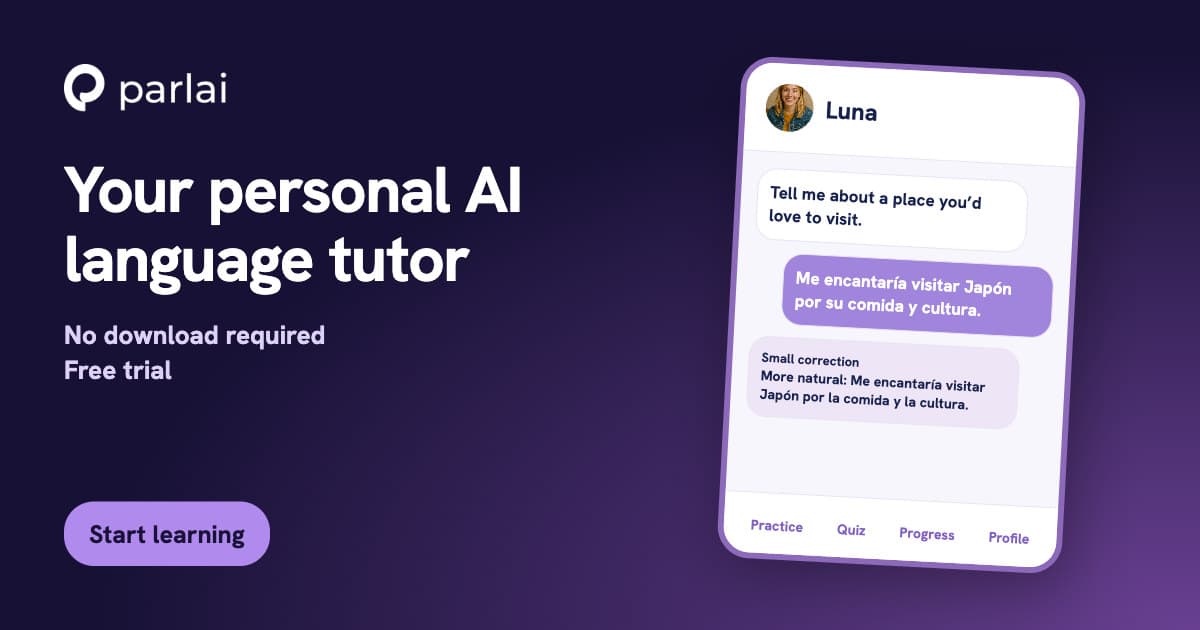
Speaking Spanish gets easier when you make it small, daily, and structured. Focus on communication first, refine second, and repeat often. If you want consistent practice with feedback, try Parlai to keep your daily speaking routine simple and steady.
Frequently Asked Questions
Speak early and often in short sessions. Focus on communicating your idea, not on perfect grammar. Consistent speaking practice is the fastest confidence builder.
No. Any consistent speaking practice helps. You can use a tutor, language exchange, or guided AI practice as long as you speak regularly and get feedback.
Paraphrase it, describe it, or use a simpler phrase. Fluency is the ability to keep the conversation moving even when vocabulary is missing.
10–20 minutes daily is enough to see progress if you do it consistently. Speaking daily beats longer weekly sessions.
Fluency comes first. Clear pronunciation helps, but your ability to keep the conversation going matters more than perfect accent.
Not sure where to start?
Find your estimated CEFR level with 12 questions, then see exactly what to improve next.
Related Articles

Ready to Start Your Language Learning Journey?
Join thousands of learners who are already improving their language skills with Parlai.